

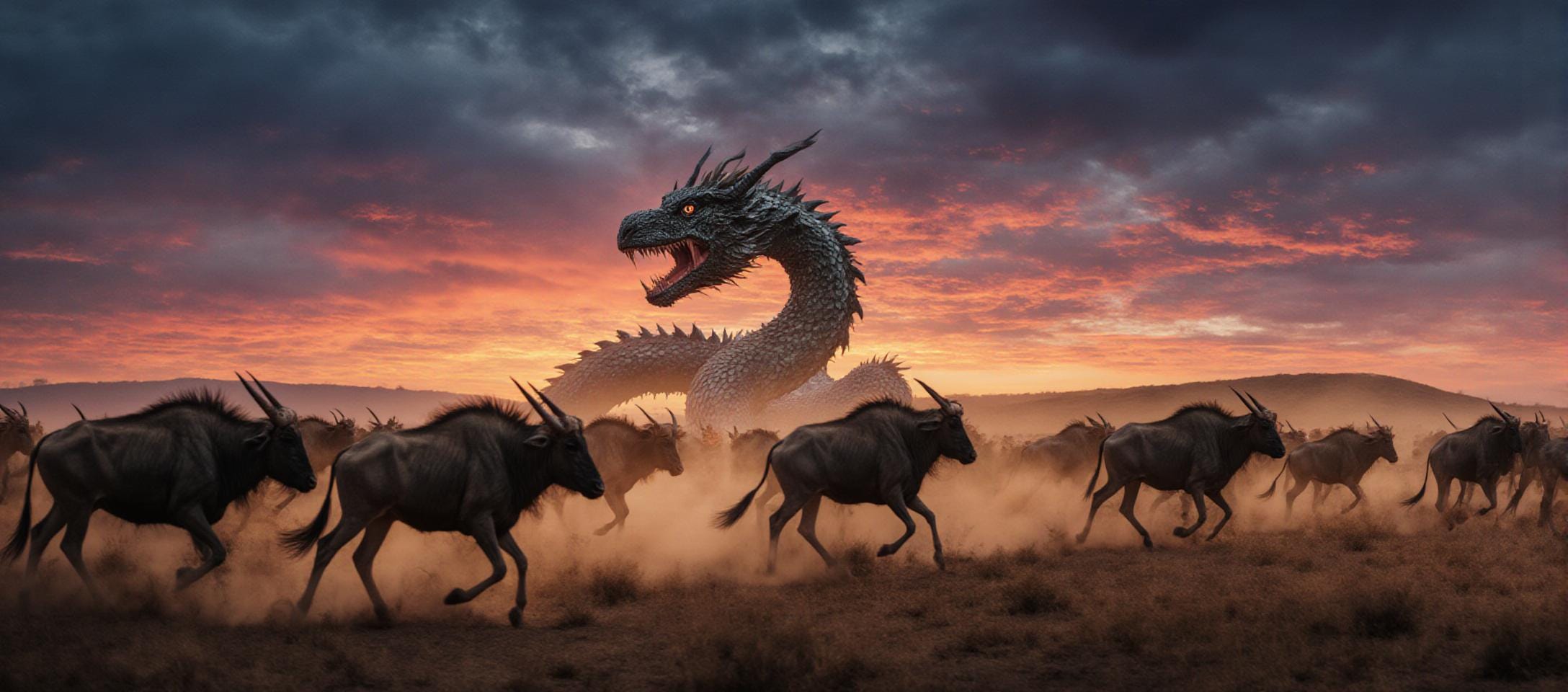
There are two ancient monsters living inside every market.
The Herd is the first. It is the fused panic and greed of millions, a single living organism that stampedes for no reason except that it has already begun to stampede. Like wildebeest on the Serengeti, it promises one thing above all: the sweet, suicidal comfort of not being the one left behind.
The Hydra is the second. It is fear itself, multi-headed and immortal. Cut one head—inflation, recession, war, plague—and two more sprout instantly in its place.
We are trapped between them.
When the Hydra snarls, the Herd runs—and the earth shakes.
The Anatomy of the Herd (Why We Run)
Herd instinct is a primal survival mechanism.
In the wild, the wildebeest that separates from the herd is the one the lions pick off. Its individuality is a death sentence. The herd, for all its mindlessness, offers one priceless commodity: anonymity. Safety in numbers.
This is the psychological pull we feel. The financial pain of being wrong is bad. But the existential pain of being wrong and alone is unbearable.
We saw this in Tulip Mania. We saw it in the dot-com bubble. We saw it in 2008. At some point, the fundamental logic of the trade (This tulip bulb is just a flower) becomes irrelevant. It is overwhelmed by the social logic of the crowd (But everyone else is getting rich, and I will be left behind).
We are wired to believe that if the entire herd is running, it must be running from something, or to something. To stand still is to risk being wrong, alone, and trampled.
The Heads of the Hydra (Why We’re Scared)
The Herd is kinetic energy. It needs a catalyst—a fear—to set it in motion. This is the Hydra.
And the Hydra is a monster for our times because it is never just one thing. Fear regenerates.
Look at the last few years. You cut off the head of the “Pandemic” fear. Two heads grow back: “Inflation” and “Supply Chain Collapse.”
You fight the “Inflation” head. The Fed raises rates, which gives birth to two new heads: a “Banking Crisis” and a “Recession.”
You try to ignore those, and a “Geopolitical” head rears up. And another. And another.
The Hydra is the financial news cycle, the Twitter feed, the rumor mill. It is a multi-headed, self-regenerating engine of anxiety. Its goal is not to be solved; its goal is to spread. And when it whispers to the Herd... the stampede begins.
“When we come together in groups, we become something more than the sum of our parts: we become a superorganism with a hive mind that can do things no individual could ever do alone.”
—Jonathan Haidt
The Mirage of “Crowd Wisdom”
This brings us to the most dangerous question: “Is the crowd right or wrong?”
Asking if the Herd is “rational” is like asking if a hurricane is “rational.” It’s a category error. The Herd is not a thinking entity. It is a force of nature. It has direction, it has momentum, and it has an unbelievable amount of (panic) energy.
The amateur tries to argue with the hurricane.
The fool tries to stand in its way.
The “expert” tries to “outsmart” it, to predict the one house it will leave standing.
The master, the true student of The Fractal Stack, doesn’t. The master climbs a nearby hill, pulls out their “dashboard,” and reads the gauges.
Then we ask:
What is its Delta (direction)? Where is it running?
What is its Gamma (acceleration)? How fast is the panic speeding up?
What is its Vega (fear level)? How much is the crowd overpaying for ‘insurance’ on its own panic?
You cannot outsmart a stampede. But you can read it.
Conclusion: The Surveyor’s View
For years, we’ve been seduced by the Big Short fantasy: the genius who gets rich by standing in front of the train. But the graveyard of Wall Street is filled with people who were right, but early.
“The market can remain irrational longer than you can remain solvent.”
—Keynes
To survive the stampede, don’t judge it. Measure it.
We use the Fractal Stack to map the physics of the present, not predicting the future; we are looking for the “Engine Stall”—the moment the car is still rolling forward, but the foot is off the gas. We are calculating the exact coordinate where the panic runs out of sellers and the physics of mean reversion kick in.
We will break down the specific tools for this (like RSI Divergence) in a future post.
For now, stay alert. We are entering the “twilight zone” of the trading year. The Herd is tired, dreaming of a “Santa Claus Rally,” and eager to close the books.
And that is exactly when the Hydra likes to wake up.
This is an exceptional and thought-provoking piece—one of the most compelling explanations of market psychology I’ve read in a long time. The fusion of mythology, behavioral finance, and real-world market dynamics makes the concepts of Herd behavior and Hydra-like fear come alive with cinematic clarity. The writing is sharp, vivid, and memorable, turning abstract ideas into visceral images that readers can instantly grasp. Most importantly, the article doesn’t just describe market panic—it reframes it, showing how true mastery lies not in fighting collective behavior but in measuring it with precision and humility. A brilliant blend of storytelling and market wisdom.